Friday, September 14, 2012

JavaScript: The Good Parts

Posted by Unknown On 2:43 AM | No comments

Book Detail 
 Paperback: 176 pages
Publisher: Yahoo Press; 1 edition (May 2008)
Language: English
ISBN-10: 0596517742
ISBN-13: 978-0596517748
File Size : 6.7 Mb | File Format : PDF + Epub

Book Description

Most programming languages contain good and bad parts, but JavaScript has more than its share of the bad, having been developed and released in a hurry before it could be refined. This authoritative book scrapes away these bad features to reveal a subset of JavaScript that's more reliable, readable, and maintainable than the language as a whole-a subset you can use to create truly extensible and efficient code.

Considered the JavaScript expert by many people in the development community, author Douglas Crockford identifies the abundance of good ideas that make JavaScript an outstanding object-oriented programming language-ideas such as functions, loose typing, dynamic objects, and an expressive object literal notation. Unfortunately, these good ideas are mixed in with bad and downright awful ideas, like a programming model based on global variables.

When Java applets failed, JavaScript became the language of the Web by default, making its popularity almost completely independent of its qualities as a programming language. In JavaScript: The Good Parts, Crockford finally digs through the steaming pile of good intentions and blunders to give you a detailed look at all the genuinely elegant parts of JavaScript, including:
  • Syntax
  • Objects
  • Functions
  • Inheritance
  • Arrays
  • Regular expressions
  • Methods
  • Style
  • Beautiful features
The real beauty? As you move ahead with the subset of JavaScript that this book presents, you'll also sidestep the need to unlearn all the bad parts. Of course, if you want to find out more about the bad parts and how to use them badly, simply consult any other JavaScript book.

With JavaScript: The Good Parts, you'll discover a beautiful, elegant, lightweight and highly expressive language that lets you create effective code, whether you're managing object libraries or just trying to get Ajax to run fast. If you develop sites or applications for the Web, this book is an absolute must.

About The Author 

Douglas Crockford is a Senior JavaScript Architect at Yahoo!, well known for introducing and maintaining the JSON (JavaScript Object Notation) format. He's a regular speaker at conferences on advanced JavaScript topics, and serves on the ECMAScript committee.

Main Contents 

Chapter 1 Good Parts
Chapter 2 Grammar
Chapter 3 Objects
Chapter 4 Functions
Chapter 5 Inheritance
Chapter 6 Arrays
Chapter 7 Regular Expressions
Chapter 8 Methods
Chapter 9 Style
Chapter 10 Beautiful Features

Appendix Awful Parts
Appendix Bad Parts
Appendix JSLint
Appendix Syntax Diagrams
Appendix JSON
Colophon

Download Ebook : JavaScript: The Good Parts


Learn JavaScript and Ajax with w3Schools

Posted by Unknown On 2:02 AM | No comments

Book Detail 
Paperback: 264 pages
Publisher: Wiley; 1 edition (June 8, 2010)
Language: English
ISBN-10: 0470611944
ISBN-13: 978-0470611944
File Size : 17.5 Mb | File Format : PDF

Book Description 

Fast, focused instruction for beginning Web developers
W3Schools.com is the number one online education source for beginning Web developers. This attractive two-color book contains concise, highly focused tutorials in the proven W3Schools instructional format, with an easy-to-use reference of JavaScript Objects and the HTML DOM included. Novice developers will quickly learn to create interactive Web pages using the most popular Web scripting language.
  • W3Schools is the top Google search result for instruction on JavaScript, HTML, CSS, and other key Web technologies; this book presents W3Schools tutorials in an easy-to-follow format for quick learning
  • Features clear examples, simple explanations, and a thorough reference section covering JavaScript Objects and the HTML DOM
  • Covers statements and comments; variables, operators, and comparisons; if…then statements; pop-up boxes; events and try…catch; objects, strings, arrays, and Booleans; cookies, validation, and timing; Ajax requests and XMLHTTP requests; Ajax suggest, and more
Designed to get beginning Web developers up and running as quickly as possible, Learn JavaScript and Ajax with W3Schools presents a proven, highly focused course of instruction in an easy-to-use format.

From the Back Cover

There's no faster, easier way to learn JavaScript and Ajax
If you want to start building interactive Web pages right away, you should begin by learning how to use JavaScript and Ajax. w3schools has perfected a straightforward tutorial approach that gives you what you need to know in manageable lessons, liberally supported with examples. You'll find that tried-and-true format in this book, along with a detailed reference section that you will use again and again.

You will learn:
  • What JavaScript is and isn't
  • How to put JavaScript into an HTML page
  • JavaScript special characters and guidelines
  • How to use JavaScript operators
  • If... else statements and do... while loops
  • All about JavaScript objects
  • How to use Ajax properties
  • What the Ajax XMLHttpRequest Object does
Add JavaScript
Define functions
Create cookies
Declare variables
Create objects
Build Ajax pages

About the Author

w3schools is a leading Web destination for learning key Web technologies online. Founded in 1999, it receives more than 10 million unique visitors each month. w3schools tutorials are required reading in more than 100 high schools and universities.

Download Ebook : Learn JavaScript and Ajax with w3Schools

Rapid : Learn JavaScript and Ajax with w3Schools

Uppit : Learn JavaScript and Ajax with w3Schools

Ziddu : Learn JavaScript and Ajax with w3Schools

MF : Learn JavaScript and Ajax with w3Schools

Thursday, September 13, 2012


Book Detail
Paperback: 344 pages
Publisher: Packt Publishing (March 18, 2011)
Language: English
ISBN-10: 1849513309
ISBN-13: 978-1849513302
File Size : 12 Mb | File Format : PDF

Book Description

Quickly master all of jQuery's animation methods and build a toolkit of ready-to-use animations using jQuery 1.4 Create both simple and complex animations using clear, step-by-step instructions, accompanied with screenshots Walk through each of jQuery's built-in animation methods and see in detail how each one can be used Over 50 detailed examples of different types of web page animations Attractive pictures and screenshots that show animations in progress and how the examples should finally appear Contains examples featuring many new HTML5 elements and CSS3 styling Follow the examples in a step-by-step approach beginning with simple concepts and building up to more advanced implementations In Detail jQuery is a cross-browser JavaScript library designed to simplify the client-side scripting of HTML, and is the most popular JavaScript library in use today. Using the features offered by jQuery, developers are able to create dynamic web pages. This book will act as a resource for you to create animation and advanced special effects in your web applications, by following the easy-to-understand steps mentioned in it. jQuery 1.4 Animation Techniques: Beginners Guide will allow you to master animation in jQuery to produce slick and attractive interfaces that respond to your visitors' interactions. You will learn everything you need to know about creating engaging and effective web page animations using jQuery. The book uses many examples and explains how to create animations using an easy, step-by-step, beginners guide approach. This book provides various examples that gradually build up the reader's knowledge and practical experience in using the jQuery API to create stunning animations. The book starts off by explaining how animations make your user interface interactive and attractive. It explains the various methods used to make the element being animated appear or disappear. It provides a set of steps to create simple.

About the Author

Dan Wellman lives with his wife and three children in his home town of Southampton on the south coast of England. By day his mild-mannered alter-ego works for a small yet accomplished e-commerce production agency. By night he battles the forces of darkness and fights for truth, justice, and less intrusive JavaScript. He has been writing computer-related articles, tutorials, and reviews for around five years and is rarely very far from a keyboard of some description. This is his fourth book.

Main Contents

Chapter 1: Introduction
Chapter 2: Fading Animations
Chapter 3: Managing Animations
Chapter 4: Sliding Animations
Chapter 5: Custom Animations
Chapter 6: Extended Animations with jQuery UI
Chapter 7: Full Page Animations
Chapter 8: Other Popular Animations
Chapter 9: CSS3 Animations
Chapter 10: Canvas Animations

Download Ebook : jQuery 1.4 Animation Techniques: Beginners Guide

Rapid : jQuery 1.4 Animation Techniques: Beginners Guide

Uppit : jQuery 1.4 Animation Techniques: Beginners Guide

Ziddu : jQuery 1.4 Animation Techniques: Beginners Guide

MF : jQuery 1.4 Animation Techniques: Beginners Guide


Book Detail 
Paperback: 540 pages
Publisher: Pogue Press; Second Edition edition (October 28, 2011)
Language: English
ISBN-10: 1449399029
ISBN-13: 978-1449399023
File Size : 9.76 Mb | File Format : Epub 

Book Description 
JavaScript lets you supercharge your HTML with animation, interactivity, and visual effects—but many web designers find the language hard to learn. This jargon-free guide covers JavaScript basics and shows you how to save time and effort with the jQuery library of prewritten JavaScript code. You’ll soon be building web pages that feel and act like desktop programs, without having to do much programming.

The important stuff you need to know:
  • Make your pages interactive. Create JavaScript events that react to visitor actions.
  • Use animations and effects. Build drop-down navigation menus, pop-ups, automated slideshows, and more.
  • Improve your user interface. Learn how the pros make websites fun and easy to use.
  • Collect data with web forms. Create easy-to-use forms that ensure more accurate visitor responses.
  • Add a dash of Ajax. Enable your web pages to communicate with a web server without a page reload.
  • Practice with living examples. Get step-by-step tutorials for web projects you can build yourself.
About the Author

David Sawyer McFarland is president of Sawyer McFarland Media, Inc., a Web development and training company in Portland, Oregon. He's been building websites since 1995, when he designed an online magazine for communication professionals. He's served as webmaster at the University of California at Berkeley and the Berkeley Multimedia Research Center, and oversaw a complete CSS-driven redesign of Macworld.com. David is also a writer and trainer, and teaches in the Portland State University multimedia program. He wrote the bestselling Missing Manual titles on Adobe Dreamweaver, CSS, and JavaScript.

Download Ebook : JavaScript and jQuery: The Missing Manual II edition

Rapidgator : JavaScript and jQuery: The Missing Manual II edition

Uppit : JavaScript and jQuery: The Missing Manual II edition

Ziddu : JavaScript and jQuery: The Missing Manual II edition

MF : JavaScript and jQuery: The Missing Manual II edition

Saturday, August 11, 2012


Foreword:

In the history of the Internet, 2005–2006 will be remembered as the year when online mapping finally came of age. Prior to 2005, MapQuest and other mapping services allowed you to look up directions, search for locations, and map businesses, but these searches were limited, usually to the companies the services had partnered with, so you couldn’t search for any location. On February 8, 2005, Google changed all that. As it does with many of its services, Google quietly released the beta of Google Maps to its Labs incubator (http://labs.google.com) and let word-of-mouth marketing promote the new service. By all accounts, Google Maps was an instant hit. It was the first free mapping service to provide satellite map views of any location on the earth, allowing anyone to look for familiar places. This started the “I can see my house from here” trend, and set the blogosphere abuzz with links to Google Maps locations around the world. Like other mapping services, Google Maps offered directions, city and town mapping, and local business searches. However, what the Google Maps engineers buried within its code was something that quickly set it apart from the rest. Although unannounced and possibly unplanned, they provided the means to manipulate the code of Google Maps to plot your own locations. Moreover, you could combine this base mapping technology with an
external data source to instantly map many location-based points of information. And all of this could be done on privately owned domains, seemingly independent of Google itself.
At first, mapping “hackers” unlocked this functionality, just as video gamers hack into games by entering simple cheat codes. They created their own mapping services using Google Maps and other sources. One of the first these was Housingmaps.com, which combined the craigslist.org housing listings with a searchable Google Maps interface. Next came Adrian Holovaty’s chicagocrime.org, which offered a compelling way to view crime data logged by the Chicago Police Department. These home-brewed mapping applications were dubbed “hacks,” since Google had not sanctioned the use of its code in external domains on the Web.
The major change came in June 2005, when Google officially introduced the Google Maps API, which is the foundation for this book. By releasing this API, Google allowed programmers the opportunity to build an endless array of applications on top of Google Maps. Hundreds of API keys were registered immediately after the announcement, and many sites integrating Google Maps appeared within days. The map mashup was born.

The Birth of the Google Maps Mania Blog.
The Google Maps labs beta site had been public for barely a month when I tried it for the first time. I was fascinated. While combing through the blogosphere looking for more information, I started to see a trend toward Google Maps hacks, how-to sites, Firefox extensions, and websites indexing specific satellite images. I thought that others could benefit from an aggregation of all of these ideas into one themed blog. Thus, my Google Maps Mania blog was born.

This book will provide you the means to take part in this evolution of the Web. I hope to be posting about the interesting and unique map creations that you build after reading this book. Your creations will inspire others to do similar things, and together, we will continue to grow the Internet, one mapping application at a time. Let me know if you build something cool!

About The Authors:

MICHAEL PURVIS is a Mechatronics Engineering student at the University of Waterloo, in Ontario. He is a mostly self-taught pro-grammer. Prior to discovering PHP, he was busy making a LEGO®Mindstorms kit play Connect 4. Currently, he maintains an activecommunity site for classmates, built mostly from home-brewed extensions to PunBB and MediaWiki. He has written about CSS for Position Is Everything, and occa-sionally participates in the css-discuss mailing list. He particularlyenjoys those clever layouts that mix negative margins, relative posi-tioning, and bizarre float tricks to create fiendish, cross-browser, flexible-width concoctions. These and other nontechnical topics are discussed on his weblog at uwmike.com.

Offline, he enjoys cooking, cycling, and social dancing. He has worked with We-Create, Inc.
on a number of PHP-based projects, and has a strong interest in independent web standards.

■JEFFREY SAMBELLS is a graphic designer and self-taught web applications developer best known for his unique ability to merge the visual world of graphics with the mental realm of code. With a Bachelor of Technology degree in Graphic Communications Management along with a minor in Multimedia, Jeffrey was originally trained for the traditional paper-and-ink printing industry, but he soon realized the world of pixels and code was where his ideas would prosper. In late 1999, he cofounded We-Create, Inc., an Internet software company based in Waterloo, Ontario, which began many long nights of challenging and creative innovation. Currently, as Director of Research and Development for We-Create, Jeffrey is responsible for investigating new and emerging Internet technologies and integrating them using web standards-compliant methods. In late 2005, he also became a Zend Certified Engineer.
When not playing at the office, Jeffrey enjoys a variety of hobbies from photography to woodworking. When the opportunity arises, he also enjoys floating in a canoe on the lakes of Algonquin Provincial Park or going on an adventurous, map-free, drive with his wife. Jeffrey also maintains a personal website at JeffreySambells.com, where he shares thoughts, ideas, and opinions about web technologies, photography, design, and more. He lives in Ontario, Canada, eh, with his wife, Stephanie, and their little dog, Milo.

■CAMERON TURNER has been programming computers since his first VIC 20 at age 7. He has been developing interactive websites since 1994. In 1999, he cofounded We-Create, Inc., which specializes in
Internet software development. He is now the company’s Chief Technology Officer. Cam obtained his Honors degree in Computer Science from the University of Waterloo with specialization in
applied cryptography, database design, and computer security. Cam lives in Canada’s technology capital of Waterloo, Ontario, with his wife, Tanya, son Owen, and dog Katie. His hobbies include
biking, hiking, water skiing, and painting. He maintains a personal blog at CamTurner.com, discussing nontechnical topics, thoughts, theories, and family life.

Download: 


Mirror:


About this book: 
Working with technology is a funny thing in that every time you think you have it cornered
. . . blam! Something pops out of nowhere that leaves you at once both bewildered and excited.
Web development seems to be particularly prone to such surprises. For instance, early on, all
we had to deal with was plain old HTML, which, aside from the never-ending table-wrangling,
was easy enough. But soon, the simple web site began to morph into a complex web applica-
tion, and accordingly, scripting languages such as PHP became requisite knowledge.
Server-side development having been long since mastered, web standards such as CSS and
XHTML were deemed the next link in the Web’s evolutionary chain.
With the emergence of Ajax, developers once again find themselves at a crossroads. How-
ever, just as was the case with the major technological leaps of the past, there’s little doubt as
to which road we’ll all ultimately take, because it ultimately leads to the conclusion of clicking
and waiting on the Web. Ajax grants users the luxury of accessing desktop-like applications
from any computer hosting a browser and Internet connection. Likewise, developers now
have more reason than ever to migrate their applications to an environment that has the
potential for unlimited users.
Yet despite all of Ajax’s promise, many web developers readily admit being intimidated by
the need to learn JavaScript (a key Ajax technology). Not to worry! I wrote this book to show
PHP users how to incorporate Ajax into their web applications without necessarily getting
bogged down in confusing JavaScript syntax, and I’ve chosen to introduce the topic by way of
practical examples and real-world instruction. The material is broken down into 14 chapters, each of which is described here:

Chapter 1: “Introducing Ajax,” puts this new Ajax technology into context, explaining the
circumstances that led to its emergence as one of today’s most talked about advance-
ments in web development.

Chapter 2: “Ajax Basics,” moves you from the why to the what, covering fundamental Ajax
syntax and concepts that will arise no matter the purpose of your application.

Chapter 3: “PHP and Ajax,” presents several examples explaining how the client and
server sides come together to build truly compelling web applications.

Chapter 4: “Database-Driven Ajax,” builds on what you learned in the previous chapter
by bringing MySQL into the picture.

Chapter 5: “Forms,” explains how Ajax can greatly improve the user experience by per-
forming tasks such as seemingly real-time forms validation.

Chapter 6: “Images,” shows you how to upload, manipulate, and display images the
Ajax way.

Chapter 7: “A Real-World Ajax Application,” applies everything you’ve learned so far to
build an Ajax-enabled photo gallery.

Chapter 8: “Ergonomic Display,” touches upon several best practices that should always
be applied when building rich Internet applications.

Chapter 9: “Web Services,” shows you how to integrate Ajax with web services, allowing
you to more effectively integrate content from providers such as Google and Amazon.

Chapter 10: “Spatially Enabled Web Applications,” introduces one of the Web’s showcase
Ajax implementations: the Google Maps API.

Chapter 11: “Cross-Browser Issues,” discusses what to keep in mind when developing
Ajax applications for the array of web browsers in widespread use today.

Chapter 12: “Security,” examines several attack vectors introduced by Ajax integration,
and explains how you can avoid them.

Chapter 13: “Testing and Debugging,” introduces numerous tools that can lessen the
anguish often involved in debugging JavaScript.

Chapter 14: “The DOM,” introduces the document object model, a crucial element in the
simplest of Ajax-driven applications.

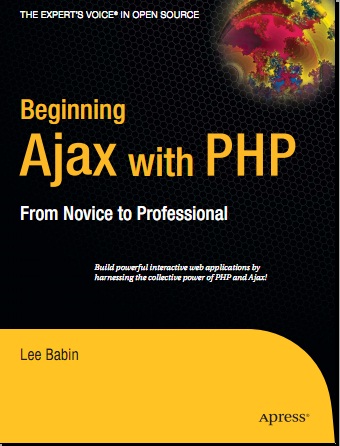
About Author:

LEE BABIN is a programmer based in Calgary, Alberta, where he owns
and operates an innovative development firm duly named Code Writer.
He has been developing complex web-driven applications since his
graduation from DeVry University in early 2002, and has since worked
on over 100 custom web sites and online applications. 
Lee is married to a beautiful woman by the name of Dianne, who
supports him in his rather full yet rewarding work schedule. Lee and
Dianne are currently expecting their first child, and Lee cannot wait to
be a father.
Lee enjoys video games, working out, martial arts, and traveling, and can usually be foundworking online on one of his many fun web projects.

Download: