Friday, September 21, 2012


Book Detail 
Hardcover: 401 pages
Publisher: Springer; 2012 edition (February 18, 2012)
Language: English
ISBN-10: 1447124421
ISBN-13: 978-1447124429
File Size : 7.8 Mb | File Format : PDF
Book Description 

This comprehensive textbook introduces readers to the three-tiered, Model-View-Controller (MVC) architecture by using Hibernate, JSPs, and Java Servlets. These three technologies all use Java, so that a student with a background in programming will be able to master them with ease, with the end result of being able to create web applications that use MVC, validate user input and save data to a database. Features: presents the many topics of web development in small steps, in an accessible, easy-to-follow style; uses powerful technologies that are freely available on the web to speed up web development, such as JSP, JavaBeans, annotations, JSTL, Java 1.5, Hibernate and Tomcat; discusses HTML, HTML Forms, Cascading Style Sheets and XML; introduces core technologies from the outset, such as the MVC architecture; contains questions and exercises at the end of each chapter, detailed illustrations, chapter summaries, and a glossary; includes examples for accessing common web services.

About the Author

Tim Downey is a Senior Instructor at the School of Computing and Information Sciences, Florida International University, Miami, FL, USA. He has more than twenty years experience teaching web development, during which he has won numerous Outstanding Teaching Awards.

Brief of Contents 

1      Browser-Server Communication
2      Controllers
3      Java Beans and Controller Helpers
4      Enhancing the Controller
5      Hibernate
6      Advanced HTML and Form Elements
7      Accounts, Cookies and Carts
8      Web Services and Legacy Databases
9      Appendix

Download Ebook : Guide to Web Development with Java: Understanding Website Creation

Rapid : Guide to Web Development with Java: Understanding Website Creation
Ziddu : Guide to Web Development with Java: Understanding Website Creation

Regular Expressions Cookbook, 2nd Edition

Posted by Unknown On 4:40 AM | 1 comment

Book Detail 
Paperback: 612 pages
Publisher: O'Reilly Media; Second Edition edition (September 3, 2012)
Language: English
ISBN-10: 1449319432
ISBN-13: 978-1449319434
File Size : 12 Mb | File Format : PDF + Epub
Book Description 

Take the guesswork out of using regular expressions. With more than 140 practical recipes, this cookbook provides everything you need to solve a wide range of real-world problems. Novices will learn basic skills and tools, and programmers and experienced users will find a wealth of detail. Each recipe provides samples you can use right away.

This revised edition covers the regular expression flavors used by C#, Java, JavaScript, Perl, PHP, Python, Ruby, and VB.NET. You’ll learn powerful new tricks, avoid flavor-specific gotchas, and save valuable time with this huge library of practical solutions.
  • Learn regular expressions basics through a detailed tutorial
  • Use code listings to implement regular expressions with your language of choice
  • Understand how regular expressions differ from language to language
  • Handle common user input with recipes for validation and formatting
  • Find and manipulate words, special characters, and lines of text
  • Detect integers, floating-point numbers, and other numerical formats
  • Parse source code and process log files
  • Use regular expressions in URLs, paths, and IP addresses
  • Manipulate HTML, XML, and data exchange formats
  • Discover little-known regular expression tricks and techniques
About the Author

Jan Goyvaerts runs Just Great Software, where he designs and develops some of the most popular regular expression software. His products include RegexBuddy, the world's only regular expression editor that emulates the peculiarities of 15 regular expression flavors, and PowerGREP, the most feature-rich grep tool for Microsoft Windows.

Steve Levithan works at Facebook as a JavaScript engineer. He has enjoyed programming for nearly 15 years, working in Tokyo, Washington D.C., Baghdad, and Silicon Valley. Steven is a leading JavaScript regular expression expert, and has created a variety of open source regular expression tools including RegexPal and the XRegExp library.

Download Ebook : Regular Expressions Cookbook, 2nd Edition


Friday, September 14, 2012


Book Detail 
Paperback: 312 pages
Publisher: Que Publishing; 1 edition (October 6, 2011)
Language: English
ISBN-10: 0789748975
ISBN-13: 978-0789748973
File Szie : 31.5 Mb | File Format : PDF
Book Description 

Join today’s new revolution in creativity and community: hackerspaces. Stop letting other people build everything for you: Do it yourself. Explore, grab the tools, get hands-on, get dirty…and create things you never imagined you could. Hack This is your glorious, full-color passport to the world of hackerspaces: your invitation to share knowledge, master tools, work together, build amazing stuff–and have a flat-out blast doing it.

Twin Cities Maker co-founder John Baichtal explains it all: what hackerspaces are, how they work, who runs them, what they’re building—and how you can join (or start!) one. Next, he walks you through 24 of today’s best hackerspace projects…everything from robotic grilled-cheese sandwich-makers to devices that make music with zaps of electricity. Every project’s packed with color photos, explanations, lists of resources and tools, and instructions for getting started on your own similar project so you can DIY!

JUST SOME OF THE PROJECTS YOU’LL LEARN ABOUT INCLUDE…
• Kung-fu fighting robots
• Home-brewed Geiger counter
• TransAtlantic balloon
• Twitter-monitoring Christmas tree
• Sandwich-making robot
• Interactive Space Invaders mural
• CNC mill that carves designs into wood, plastic and metal
• Telepresence robot that runs an Internet classroom
• Toy cars that are ridden by people
• Bronze-melting blast furnace
• Laptop-controlled robot fashioned from a wheelchair
• DIY book scanner

JOHN BAICHTAL is a founding member of Twin Cities Maker, a hackerspace organization that has been collaborating for almost two years. Based in Minneapolis-St. Paul, Minnesota, Twin  ities Maker has its own rented warehouse complete with a welding station, woodshop, classroom, and ham radio transmitter. Baichtal has written dozens of articles, including pieces for AKE, the D&D publication Kobold Quarterly, and 2600: The Hacker Quarterly. He has contributed to Wired.com’s GeekDad blog for four years and blogged at Make: Online for two, publishing more than 1,500 posts during that time. He is now writing a book about Lego.

About the Author

John Baichtal is the founding member of Twin Cities Maker, a hackerspace organization that has been collaborating for almost two years. Twin Cities Maker has its own rented warehouse, the Hack Factory, complete with a welding station, a woodshop, a classroom, and an electronics area. John is currently writing The Cult of Lego, a book about adult Lego builders for No Starch Press. He has written dozens of articles for print, including pieces for MAKE Magazine, Kobold Quarterly (a D&D magazine), and 2600: The Hacker Quarterly. He has blogged for Wired.com (GeekDad blog) for four years and Make: Online for a year, with more than 1,000 posts published during that time.

Download Ebook : Hack This: 24 Incredible Hackerspace Projects from the DIY Movement

Rapid : Hack This: 24 Incredible Hackerspace Projects from the DIY Movement
Ziddu : Hack This: 24 Incredible Hackerspace Projects from the DIY Movement

Saturday, September 8, 2012

CMOS Processors and Memories

Posted by Unknown On 12:04 AM | 1 comment

Book Detail

Hardcover: 386 pages
Publisher: Springer; 1st Edition. edition (August 23, 2010)
Language: English
ISBN-10: 9048192153
ISBN-13: 978-9048192151
File Size : 9.4 Mb | File Format : PDF

Book Description

CMOS Processors and Memories addresses the-state-of-the-art in integrated circuit design in the context of emerging computing systems. New design opportunities in memories and processor are discussed. Emerging materials that can take system performance beyond standard CMOS, like carbon nanotubes, graphene, ferroelectrics and tunnel junctions are explored. CMOS Processors and Memories is divided into two parts: processors and memories. In the first part we start with high performance, low power processor design, followed by a chapter on multi-core processing. They both represent state-of-the-art concepts in current computing industry. The third chapter deals with asynchronous design that still carries lots of promise for future computing needs. At the end we present a “hardware design space exploration” methodology for implementing and analyzing the hardware for the Bayesian inference framework. This particular methodology involves: analyzing the computational cost and exploring candidate hardware components, proposing various custom architectures using both traditional CMOS and hybrid nanotechnology CMOL. The first part concludes with hybrid CMOS-Nano architectures. The second, memory part covers state-of-the-art SRAM, DRAM, and flash memories as well as emerging device concepts. Semiconductor memory is a good example of the full custom design that applies various analog and logic circuits to utilize the memory cell’s device physics. Critical physical effects that include tunneling, hot electron injection, charge trapping (Flash memory) are discussed in detail. Emerging memories like FRAM, PRAM and ReRAM that depend on magnetization, electron spin alignment, ferroelectric effect, built-in potential well, quantum effects, and thermal melting are also described. CMOS Processors and Memories is a must for anyone serious about circuit design for future computing technologies. The book is written by top notch international experts in industry and academia. It can be used in graduate course curriculum.

About the Author

Krzysztof (Kris) Iniewski is managing R&D at Redlen Technologies Inc., a start-up company in British Columbia. His research interests are in VLSI circuits for medical and security applications. He is also an executive director of CMOS Emerging Technologies (www.cmoset.com). From 2004 to 2006 he was an Associate Professor at the Electrical Engineering and Computer Engineering Department of University of Alberta where he conducted research on low power wireless circuits and systems. During his tenure in Edmonton he put together a book for CRC Press "Wireless Technologies: Circuits, Systems and Devices". From 1995 to 2003, he was with PMC-Sierra and held various senior technical and management positions. Prior to joining PMC-Sierra, from 1990 to 1994 he was an Assistant Professor at the University of Toronto’s Electrical Engineering and Computer Engineering. Dr. Iniewski has published over 100 research papers in international journals and conferences. He holds 18 international patents granted in USA, Canada, France, Germany, and Japan. He received his Ph.D. degree in electronics (honors) from the Warsaw University of Technology (Warsaw, Poland) in 1988. Together with Carl McCrosky and Dan Minoli he is an author of "Data Networks – VLSI and Optical Fibre", Wiley, 2008. He recently edited "Medical Imaging Electronics", Wiley 2009, "VLSI Circuits for Bio-medical applications", Artech House 2008, and "Circuits at Nanoscale: Communications, Imaging and Sensing", CRC Press 2008.

Download Ebook : CMOS Processors and Memories

Rapid : CMOS Processors and Memories
Ziddu : CMOS Processors and Memories

Friday, September 7, 2012

Think Complexity

Posted by Unknown On 4:29 AM | 1 comment

Book Detail 
Paperback: 160 pages
Publisher: O'Reilly Media; 1 edition (March 9, 2012)
Language: English
ISBN-10: 1449314635
ISBN-13: 978-1449314637
File Size : 9.5 Mb | File Format : PDF + Epub
Book Description 

Expand your Python skills by working with data structures and algorithms in a refreshing context—through an eye-opening exploration of complexity science. Whether you’re an intermediate-level Python programmer or a student of computational modeling, you’ll delve into examples of complex systems through a series of exercises, case studies, and easy-to-understand explanations.

You’ll work with graphs, algorithm analysis, scale-free networks, and cellular automata, using advanced features that make Python such a powerful language. Ideal as a text for courses on Python programming and algorithms, Think Complexity will also help self-learners gain valuable experience with topics and ideas they might not encounter otherwise.
  • Work with NumPy arrays and SciPy methods, basic signal processing and Fast Fourier Transform, and hash tables
  • Study abstract models of complex physical systems, including power laws, fractals and pink noise, and Turing machines
  • Get starter code and solutions to help you re-implement and extend original experiments in complexity
  • Explore the philosophy of science, including the nature of scientific laws, theory choice, realism and instrumentalism, and other topics
  • Examine case studies of complex systems submitted by students and readers
About the Author

Allen Downey is a Professor of Computer Science at the Olin College of Engineering and a former Visiting Scientist at Google, Inc. He has taught computer science at Wellesley College, Colby College and U.C. Berkeley. He has a Ph.D. in Computer Science from U.C. Berkeley and Master's and Bachelor's degrees from MIT.

Brief of Contents 

Chapter 01 Complexity Science
Chapter 02 Graphs
Chapter 03 Analysis of Algorithms
Chapter 04 Small World Graphs
Chapter 05 Scale-Free Networks
Chapter 06 Cellular Automata
Chapter 07 Game of Life
Chapter 08 Fractals
Chapter 09 Self-Organized Criticality
Chapter 10 Agent-Based Models
Chapter 11 Case Study: Sugarscape
Chapter 12 Case Study: Ant Trails
Chapter 13 Case Study: Directed Graphs and Knots
Chapter 14 Case Study: The Volunteer’s Dilemma
Appendix Call for Submissions

Download Ebook : Think Complexity

Rapid : Think Complexity
Ziddu : Think Complexity

Thursday, September 6, 2012


Book Detail 

Paperback: 336 pages
Publisher: Pragmatic Bookshelf (February 7, 2012)
Language: English
ISBN-10: 1934356808
ISBN-13: 978-1934356807
File Size : 4.75 Mb | File Format : PDF

Book Description 


Your customers want rock-solid, bug-free software that does exactly what they expect it to do. Yet they can't always articulate their ideas clearly enough for you to turn them into code. The Cucumber Book dives straight into the core of the problem: communication between people. Cucumber saves the day; it's a testing, communication, and requirements tool - all rolled into one.

We'll show you how to express your customers' wild ideas as a set of clear, executable specifications that everyone on the team can read. You'll learn how to feed those examples into Cucumber and let it guide your development. You'll build just the right code to keep your customers happy, and not a line more.

The first part of the book teaches you how to use the core features of Cucumber. You'll learn how to use Cucumber's Gherkin DSL to describe-- in plain language - the behavior your customers want from the system. You'll learn how to write Ruby code that interprets those plain language specifications and checks them against your application. In Part 2, you'll consolidate the knowledge you just gained with a worked example.

Although it was born in the Ruby community, you can use Cucumber to test almost any system, from a simple shell script or a Perl script, to enterprise PHP or a Java web application. In Part 3, you'll find a selection of recipes for some of the most common situations you'll encounter using Cucumber in the wild. You'll learn how to test Ajax-heavy web applications with Capybara and Selenium, REST web services, Ruby on Rails applications, command-line applications, legacy applications and lots more!

Written by the creator of Cucumber and one of its most experienced users and contributors, The Cucumber Book is an authoritative guide that will give you and your team all the knowledge you need to start using Cucumber with confidence.

What You Need:

Windows, Mac OS X (with XCode) or Linux
Ruby 1.9.2 and upwards


About the Author

Matt Wynne works as an independent consultant, helping teams like yours learn to enjoy delivering software to the best of their abilities. In his spare time he is a core developer on the Cucumber project, and he blogs at http://blog.mattwynne.net and tweets as @mattwynne

Aslak Hellesoy is the founder of the Cucumber project and works as a senior developer with DRW Trading in London, writing very fast and very smart software in several different programming languages. In his previous job he was the Chief Scientist of BEKK Consulting in Norway. Aslak tweets as @aslak_hellesoy.

Download Ebook : The Cucumber Book: Behaviour-Driven Development for Testers and Developers

Rapid : http://adf.ly/D4h0H


Wednesday, September 5, 2012

Machine Learning in Action

Posted by Unknown On 3:09 AM | 1 comment

Book Detail 
Paperback: 384 pages
Publisher: Manning Publications (April 16, 2012)
Language: English
ISBN-10: 1617290181
ISBN-13: 978-1617290183
File Size : 8.15 Mb | File Format : PDF
Book Description 

Summary
Machine Learning in Action is unique book that blends the foundational theories of machine learning with the practical realities of building tools for everyday data analysis. You'll use the flexible Python programming language to build programs that implement algorithms for data classification, forecasting, recommendations, and higher-level features like summarization and simplification.

About the Book

A machine is said to learn when its performance improves with experience. Learning requires algorithms and programs that capture data and ferret out the interesting or useful patterns. Once the specialized domain of analysts and mathematicians, machine learning is becoming a skill needed by many.

Machine Learning in Action is a clearly written tutorial for developers. It avoids academic language and takes you straight to the techniques you'll use in your day-to-day work. Many (Python) examples present the core algorithms of statistical data processing, data analysis, and data visualization in code you can reuse. You'll understand the concepts and how they fit in with tactical tasks like classification, forecasting, recommendations, and higher-level features like summarization and simplification.

Readers need no prior experience with machine learning or statistical processing. Familiarity with Python is helpful.

Purchase includes free PDF, ePub, and Kindle eBooks downloadable at manning.com.

What's Inside
  • A no-nonsense introduction
  • Examples showing common ML tasks
  • Everyday data analysis
  • Implementing classic algorithms like Apriori and Adaboos
===================================

Table of Contents

PART 1 CLASSIFICATION
01. Machine learning basics
02. Classifying with k-Nearest Neighbors
03. Splitting datasets one feature at a time: decision trees
04. Classifying with probability theory: naïve Bayes
05. Logistic regression
06. Support vector machines
07. Improving classification with the AdaBoost meta algorithm

PART 2 FORECASTING NUMERIC VALUES WITH REGRESSION
08. Predicting numeric values: regression
09. Tree-based regression

PART 3 UNSUPERVISED LEARNING
10. Grouping unlabeled items using k-means clustering
11. Association analysis with the Apriori algorithm
12. Efficiently finding frequent itemsets with FP-growth

PART 4 ADDITIONAL TOOLS
13. Using principal component analysis to simplify data
14. Simplifying data with the singular value decomposition
15. Big data and MapReduce

Download Ebook : Machine Learning in Action

Rapid : Machine Learning in Action
Ziddu : Machine Learning in Action

Tuesday, September 4, 2012

Machine Learning for Hackers

Posted by Unknown On 3:25 AM | 1 comment

Book Detail 
Paperback: 324 pages
Publisher: O'Reilly Media; 1 edition (February 22, 2012)
Language: English
ISBN-10: 1449303714
ISBN-13: 978-1449303716
File Size : 20 Mb | File Format : PDF
Book Description 

If you’re an experienced programmer interested in crunching data, this book will get you started with machine learning—a toolkit of algorithms that enables computers to train themselves to automate useful tasks. Authors Drew Conway and John Myles White help you understand machine learning and statistics tools through a series of hands-on case studies, instead of a traditional math-heavy presentation.

Each chapter focuses on a specific problem in machine learning, such as classification, prediction, optimization, and recommendation. Using the R programming language, you’ll learn how to analyze sample datasets and write simple machine learning algorithms. Machine Learning for Hackers is ideal for programmers from any background, including business, government, and academic research.
  • Develop a naïve Bayesian classifier to determine if an email is spam, based only on its text
  • Use linear regression to predict the number of page views for the top 1,000 websites
  • Learn optimization techniques by attempting to break a simple letter cipher
  • Compare and contrast U.S. Senators statistically, based on their voting records
  • Build a “whom to follow” recommendation system from Twitter data
About The Authors 

Drew Conway is a PhD candidate in Politics at NYU. He studies international relations, conflict, and terrorism using the tools of mathematics, statistics, and computer science in an attempt to gain a deeper understanding of these phenomena. His academic curiosity is informed by his years as an analyst in the U.S. intelligence and defense communities.

John Myles White is a PhD candidate in Psychology at Princeton. He studies pattern recognition, decision-making, and economic behavior using behavioral methods and fMRI. He is particularly interested in anomalies of value assessment.

Brief of Contents 

Chapter 1 Using R
Chapter 2 Data Exploration
Chapter 3 Classification: Spam Filtering
Chapter 4 Ranking: Priority Inbox
Chapter 5 Regression: Predicting Page Views
Chapter 6 Regularization: Text Regression
Chapter 7 Optimization: Breaking Codes
Chapter 8 PCA: Building a Market Index
Chapter 9 MDS: Visually Exploring US Senator Similarity
Chapter 10 kNN: Recommendation Systems
Chapter 11 Analyzing Social Graphs
Chapter 12 Model Comparison

Download Ebook : Machine Learning for Hackers


Monday, September 3, 2012

Programming Entity Framework: DbContext

Posted by Unknown On 2:53 AM | 1 comment

Book Detail 
Paperback: 258 pages
Publisher: O'Reilly Media (March 7, 2012)
Language: English
ISBN-10: 1449312969
ISBN-13: 978-1449312961
File Size : 5.28 Mb | File Format : PDF
Book Description 

The DbContext API captures Entity Framework’s (EF) most commonly used features and tasks, simplifying development with EF. This concise book shows you how to use the API to perform set operations with the DbSet class, handle change tracking and resolve concurrency conflicts with the Change Tracker API, and validate changes to your data with the Validation API.

With DbContext, you’ll be able to query and update data, whether you’re working with individual objects or graphs of objects and their related data. You’ll find numerous C# code samples to help you get started. All you need is experience with Visual Studio and database management basics.
  • Use EF’s query capabilities to retrieve data, and use LINQ to sort and filter data
  • Learn how to add new data, and change and delete existing data
  • Use the Change Tracker API to access information EF keeps about the state of entity instances
  • Control change tracking information of entities in disconnected scenarios, including NTier applications
  • Validate data changes before they’re sent to the database, and set up validation rules
  • Bypass EF’s query pipeline and interact directly with the database
About the Author

Julia Lerman is the leading independent authority on the Entity Framework and has been using and teaching the technology since its inception in 2006. She is well known in the .NET community as a Microsoft MVP, ASPInsider, and INETA Speaker. Julia is a frequent presenter at technical conferences around the world and writes articles for many well-known technical publications including the Data Points column in MSDN Magazine.

Julia lives in Vermont with her husband, Rich, and gigantic dog, Sampson, where she runs the Vermont.NET User Group. You can read her blog at www.thedatafarm.com/blog and follow her on Twitter at julielerman.

Rowan is based in Seattle, Washington and works as a Program Manager for the ADO.Net Entity Framework team at Microsoft. Prior to moving to the US he resided in the small state of Tasmania in Australia. Rowan speaks at technical conferences and blogs at http://romiller.com. Outside of technology Rowan's passions include snowboarding, mountain biking, horse riding, rock climbing and pretty much anything else that involves being active. The primary focus of his life, however, is to follow Jesus.

Brief of Contents 

Chapter 1 Introducing the DbContext API
Chapter 2 Querying with DbContext
Chapter 3 Adding, Changing, and Deleting Entities
Chapter 4 Working with Disconnected Entities Including N-Tier Applications
Chapter 5 Change Tracker API
Chapter 6 Validating with the Validation API
Chapter 7 Customizing Validations
Chapter 8 Using DbContext in Advanced Scenarios
Chapter 9 What’s Coming Next for Entity Framework

Download Ebook : Programming Entity Framework: DbContext


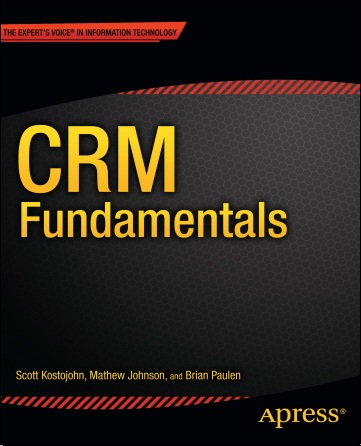
CRM Fundamentals

Posted by Unknown On 1:51 AM | 1 comment

Book Detail 
Paperback: 248 pages
Publisher: Apress; 1 edition (October 10, 2011)
Language: English
ISBN-10: 143023590X
ISBN-13: 978-1430235903
File Size : 12.5 Mb | File Format : PDF + Epub
Book Description

CRM Fundamentals is a critical and comprehensive resource for executives and project leaders tasked with managing customer relationship management (CRM) initiatives. It provides an introduction to CRM and how it delivers value to organizations, and describes the process to build and execute a CRM roadmap successfully—including identifying goals, lining up the right people, planning projects, choosing software packages and consultants, managing the initial CRM implementation, and maintaining and evolving the program over time.

Written by  senior CRM consultants, CRM Fundamentals includes plenty of detailed, useful advice to help you get the most value from your CRM investments and to avoid common pitfalls associated with CRM.

What you’ll learn
  • The real issues surrounding implementation of CRM
  • Processes, procedures and planning to make it work and on time
  • An agile approach to creating a working CRM system
  • Software and hardware suggestions for all levels of CRM implementation
Based on years of implementing CRM systems, the authors know the keys to success, the issues that can create problems and the steps needed to ensure the success of the project.

Who this book is for

This book is perfect for executives interested in launching a new CRM program or managing and evolving an existing one. CRM Fundamentals will also benefit project managers leading CRM system selection or implementation projects.

Table of Contents

1. Introduction
2. Components of CRM Success
3. Building a CRM Roadmap
4. Evaluating Software and Consultants
5. Planning the Initial CRM Implementation
6. Executing the Initial CRM Implementation
7. Maintaining and Evolving CRM

Download Ebook : CRM Fundamentals

Rapid : CRM Fundamentals
Ziddu : CRM Fundamentals