Friday, October 5, 2012

Programming Hive

Posted by Unknown On 2:26 AM | 1 comment

Book Details 
Paperback: 352 pages
Publisher: O’Reilly Media (September 2012)
Language: English
ISBN-10: 1449319335
ISBN-13: 978-1449319335
File Size: 6.6 Mb | File Format : PDF + Epub
Book Description 

Need to move a relational database application to Hadoop? This comprehensive guide introduces you to Apache Hive, Hadoop’s data warehouse infrastructure. You’ll quickly learn how to use Hive’s SQL dialect—HiveQL—to summarize, query, and analyze large datasets stored in Hadoop’s distributed filesystem.

This example-driven guide shows you how to set up and configure Hive in your environment, provides a detailed overview of Hadoop and MapReduce, and demonstrates how Hive works within the Hadoop ecosystem. You’ll also find real-world case studies that describe how companies have used Hive to solve unique problems involving petabytes of data.
  • Use Hive to create, alter, and drop databases, tables, views, functions, and indexes
  • Customize data formats and storage options, from files to external databases
  • Load and extract data from tables—and use queries, grouping, filtering, joining, and other conventional query methods
  • Gain best practices for creating user defined functions (UDFs)
  • Learn Hive patterns you should use and anti-patterns you should avoid
  • Integrate Hive with other data processing programs
  • Use storage handlers for NoSQL databases and other datastores
  • Learn the pros and cons of running Hive on Amazon’s Elastic MapReduce
Table of Contents

Chapter 01. Introduction
Chapter 02. Getting Started
Chapter 03. Data Types and File Formats
Chapter 04. HiveQL: Data Definition
Chapter 05. HiveQL: Data Manipulation
Chapter 06. HiveQL: Queries
Chapter 07. HiveQL: Views
Chapter 08. HiveQL: Indexes
Chapter 09. Schema Design
Chapter 10. Tuning
Chapter 11. Other File Formats and Compression
Chapter 12. Developing
Chapter 13. Functions
Chapter 14. Streaming
Chapter 15. Customizing Hive File and Record Formats
Chapter 16. Hive Thrift Service
Chapter 17. Storage Handlers and NoSQL
Chapter 18. Security
Chapter 19. Locking
Chapter 20. Hive Integration with Oozie
Chapter 21. Hive and Amazon Web Services (AWS)
Chapter 22. HCatalog
Chapter 23. Case Studies

Download Ebook : Programming Hive

Mirror : 

Friday, September 28, 2012


Book Detail 
Hardcover: 832 pages
Publisher: Cisco Press; 2 edition (June 22, 2012)
Language: English
ISBN-10: 1587204479
ISBN-13: 978-1587204470
File Size : 38 Mb | File Format : PDF
Book Description

The official study guide helps you master all the topics on the CCNP Security VPN exam, including
Configuring policies, inheritance, and attributes

·         AnyConnect Remote Access VPN solutions
·         AAA and Dynamic Access Policies (DAP)
·         High availability and performance
·         Clientless VPN solutions
·         SSL VPN with Cisco Secure Desktop
·         Easy VPN solutions
·         IPsec VPN clients and site-to-site VPNs

This volume is part of the Official Cert Guide Series from Cisco Press. Books in this series provide officially developed exam preparation materials that offer assessment, review, and practice to help Cisco Career Certification candidates identify weaknesses, concentrate their study efforts, and enhance their confidence as exam day nears.

CCNP Security VPN 642-648 Official Cert Guide is a best of breed Cisco exam study guide that focuses specifically on the objectives for the CCNP Security VPN exam. Cisco Certified Internetwork Expert (CCIE) Howard Hooper shares preparation hints and test-taking tips, helping you identify areas of weakness and improve both your conceptual knowledge and hands-on skills. Material is presented in a concise manner, focusing on increasing your understanding and retention of exam topics.

CCNP Security VPN 642-648 Official Cert Guide presents you with an organized test-preparation routine through the use of proven series elements and techniques. “Do I Know This Already?” quizzes open each chapter and enable you to decide how much time you need to spend on each section. Exam topic lists make referencing easy. Chapter-ending Exam Preparation Tasks help you drill on key concepts you must know thoroughly.

The companion CD-ROM contains a powerful testing engine that enables you to focus on individual topic areas or take a complete, timed exam. The assessment engine also tracks your performance and provides feedback on a module-by-module basis, laying out a complete assessment of your knowledge to help you focus your study where it is needed most.

Well-regarded for its level of detail, assessment features, and challenging review questions and exercises, this official study guide helps you master the concepts and techniques that will enable you to succeed on the exam the first time.
CCNP Security VPN 642-648 Official Cert Guide is part of a recommended learning path from Cisco that includes simulation and hands-on training from authorized Cisco Learning Partners and self-study products from Cisco Press. To find out more about instructor-led training, e-learning, and hands-on instruction offered by authorized Cisco Learning Partners worldwide, please visit www.cisco.com/go/authorizedtraining.

About the Author

Howard Hooper, CCIE No. 23470, CCNP, CCNA, CCDA, JNCIA, works as a network consultant and trainer for Transcend Networks Ltd., specializing in network design, installation, and automation for enterprise and government clients. He has worked in the network industry for 10 years, starting his career in the service provider field as a support engineer, before moving on to installations engineer and network architect roles, working on small, medium, enterprise, and service provider networks. In his spare time, Howard is a professional skydiver and Cisco Academy instructor. When he is not freefalling from more than 13,500 feet at his local drop zone, he is teaching the CCNA syllabus at his local Cisco Academy.

Download Ebook : CCNP Security VPN 642-648 Official Cert Guide, 2nd Edition

CCNP Security VPN 642-648 Official Cert Guide, 2nd Edition
Mirror :
CCNP Security VPN 642-648 Official Cert Guide, 2nd Edition
Mirror :
CCNP Security VPN 642-648 Official Cert Guide, 2nd Edition

Saturday, September 22, 2012


Book Detail 
Paperback: 192 pages
Publisher: Peachpit Press; 1 edition (February 29, 2012)
Language: English
ISBN-10: 0321819519
ISBN-13: 978-0321819512
File Size : 56.3 Mb | File Format : Epub
Book Description 

iPhoto '11 helps you organize, edit, and share your photos. With iPhoto '11 it's easy to organize and manage the thousands (maybe tens of thousands) of photos on your Mac by Faces, Places, and Events. iPhoto '11 also comes with editing and enhancement tools that rival those in expensive photo software. And finally Share what you shoot by publishing photos to your Facebook page and Flickr account or liven up someone's inbox with a beautiful email message designed with your photos. And do it all without leaving iPhoto. Let this book be your complete guide to managing all that iPhoto '11 has to offer. Beyond what other books offer this book guides you in how to work with iPhoto '11 today including integration with with the brand new iCloud service and OS X Lion.

Table of Contents
  • iPhoto at a Glance
  • The Essentials of Digital Imaging
  • Importing Photos from a Camera
  • Importing Photos with iCloud’s Photo Stream
  • How Photo Stream Works
  • After the Import
  • More Ways to Import Photos
  • Importing Tips
  • Browsing Your Photo Library
  • Tips for Working with Events
  • Adding Titles and Captions
  • Faces at a Glance
  • Working with Faces
  • Tips for Faces
  • Places at a Glance
  • Adding a New Place
  • Exploring and Browsing Places
  • Tips for Places
  • Assigning Keywords and Ratings
  • Searching for Photos
  • Creating Albums
  • Tips for Working with Albums Creating Smart Albums
  • Smart Albums, Faces, and Places
  • Basic Photo Editing
  • Fixing Composition Problems and Red-Eye
  • Enhancing and Retouching Photos
  • Applying Effects to Photos
  • Advanced Editing and the Adjust Pane
  • Adjusting Exposure and Levels
  • Adjusting Defi nition, Shadows, and Highlights
  • Changing a Photo’s Colors
  • Sharpening and Reducing Noise
  • The Big Picture: Full-Screen Editing
  • Editing Tips
  • Shooting in Raw Mode
  • Working with Raw Images
  • Using iPhoto with Photoshop
  • Slide Shows: iPhoto as Projector
  • Customizing Instant Slide Shows
  • Creating a Slide Show Project
  • Creative Options for Slide Show Projects
  • Slide Show Tips
  • More Slide Show Tips
  • Sharing Photos via Email
  • Tips for Emailing Photos
  • Sharing Photos on Facebook
  • Tips for Facebook Publishing
  • Sharing Photos on Flickr
  • Tips for Flickr Publishing
  • Sharing Photos on a Network
  • Printing Photos
  • Customizing a Print Job
  • Printing Tips and Troubleshooting
  • Ordering Prints
  • Creating Photo Books
  • Planning for Publishing
  • Book Layout Techniques
  • More Book Layout Techniques
  • Creating Travel Maps
  • Tips for Creating Books
  • More Tips for Creating Books
  • Creating a Photo Calendar
  • Tips for Creating Calendars
  • Creating Greeting Cards and Postcards
  • More Ways to Share Photos
  • Burning Photos to CDs and DVDs
  • Creating and Managing Photo Libraries
  • Getting Old Photos into iPhoto
  • iPhoto Tips
  • More iPhoto Tips
  • Mastering Your Digital Camera
  • Tips for Better Digital Photography
  • Index
Download Ebook : iPhoto '11: The Macintosh iLife Guide to using iPhoto with OS X Lion and iCloud
iPhoto '11: The Macintosh iLife Guide to using iPhoto with OS X Lion and iCloud

Friday, September 21, 2012

Learn Objective-C on the Mac, 2nd Edition

Posted by Unknown On 7:54 PM | 1 comment

Book Detail 
Paperback: 336 pages
Publisher: APRESS; 1 edition (30 Dec 2008)
Language: English
ISBN-10: 1430218150
ISBN-13: 978-1430218159
File Size : 11.4 Mb | File Format : PDF
Book Description 

Take your coding skills to the next level with this extensive guide to Objective–C, the native programming language for developing sophisticated software applications for Mac OS X. Objective–C is a powerful, object–oriented extension of C, making this book the perfect follow–up to Dave Mark’s bestselling Learn C on the Mac, Mac OS X Edition. Whether you’re an experienced C programmer or you’re coming from a different language such as C++ or Java, leading Mac experts Mark Dalrymple and Scott Knaster show you how to harness the powers of Objective–C in your applications!
  • A complete course on the basics of Objective–C using Apple’s free Xcode tools
  • An introduction to object–oriented programming
  • Comprehensive coverage of inheritance, composition, object initialization, categories, protocols, memory management, and organizing source files
  • A brief tour of Cocoa’s foundation framework and AppKit
  • A helpful “learning curve” guide for non–C developers
What you’ll learn
  • Learn Objective–C programming, the gateway to programming your Mac or iPhone
  • Write applications for the Mac OS X interface, the cleanest user–interface around
  • Understand variables and how to design your own data structures
  • Work with the file system
  • Connect to data sources and the Internet
Who this book is for

For anyone wanting to learn to program native applications in Mac OS X, including developers new to the Mac, developers new to Objective–C, or students entirely new to programming.

Download Ebook : Learn Objective-C on the Mac, 2nd Edition

Rapid : Learn Objective-C on the Mac, 2nd Edition
Ziddu : Learn Objective-C on the Mac, 2nd Edition

Wednesday, September 19, 2012

Project Management For Dummies

Posted by Unknown On 4:00 PM | 1 comment

Book Detail 
Paperback: 384 pages
Publisher: For Dummies; 3 edition (May 3, 2010)
Language: English
ISBN-10: 0470574526
ISBN-13: 978-0470574522
File Size : 4 Mb | File Format : PDF
Book Description 

From the Back Cover
The tools you need for successful project management:
In today's time-crunched, cost-conscious global business environment, tight project deadlines and stringent expectations are the norm. So what does it take to succeed? This hands-on guide introduces you to the principles of project management and shows you how to put them to use so you can successfully manage a project from start to finish. And if you're studying for the Project Management Institute's Project Management Professional certification exam, you can rest easy knowing that this book is aligned with the guide that's the basis for the exam.
  • Project management 101 — take a look at the who, what, and why of a project and discover what it really takes to ensure success
  • Keep an eye on the clock — learn how to create foolproof schedules and budgets that keep your projects on track
  • Put your team to work — get plenty of practical tips and guidelines for identifying and involving key players
  • Drive it home — uncover the best ways to track, analyze, and report on your project's activities and bring it to a successful closure
  • Up your project management game — take your skills to the next level with the use of technology and Earned Value Management
Open the book and find:
  • Help for defining your project's goals and expectations
  • Guidelines for knowing your project's audience
  • Tips for breaking your project work into manageable pieces
  • The latest methods for determining and managing resources
  • How to deal with risk and uncertainty
  • Hints for providing effective leadership
Learn to:
  • Organize and schedule projects efficiently and effectively
  • Motivate any team to gain maximum productivity
  • Assess risks, manage changes, maintain communication, and live up to expectations
  • Plan for resources and stay within a budget
About the Author

Stanley E. Portny is a project management consultant and a certified Project Management Professional (PMP). He has provided training and consultation to more than 150 public and private organizations, and he has developed and conducted training programs for more than 50,000 management and staff personnel.

Download Ebook : Project Management For Dummies

Rapid : Project Management For Dummies

Ziddu : Project Management For Dummies

Mastering Prezi for Business Presentations

Posted by Unknown On 3:29 PM | 1 comment

Book Detail 
Print Length: 260 pages
Publisher: Packt Publishing (July 25, 2012)
Language: English
ASIN: B008OURWLI
ISBN: 1849693021
File Size : 11.5 Mb | File Format : PDF
Book Description 

Accompanied by plenty of tips and tricks, this tutorial style book has ample examples and screenshots to ease your learning curve. If you use Prezi in business and want to take your presentations to the next level, or if you want to become the office Prezi guru, this book is for you.

About The Author 

Russell Anderson-Williams (Bristol, UK) is the founder of http://www.theprezenter.com which is dedicated to educating Prezi users in best practice, sharing advice and tips in design, and more than anything, changing the mindset of Prezi users to that of a non-linear thinker. A wildly creative and visual thinker, Russell has a strong background in visual communication and graphic design, as well as a long career in training and education. Russell has designed and delivered hundreds of visually stimulating training presentations for some of the world's biggest companies in a variety of sectors. By merging his love and passion for educating people with his joy for all things wonderfully visual, he has set a course to turn anyone in the business world into a Prezi Master through his on-site training programs, and tirelessly blogs about everything Prezi-related. He resides in the extremely creative city of Bristol in the United Kingdom where he works in training design, Prezi design and training, and anything else that allows his creativity to run wild.

Brief of Contents 

Chapter 1: Best Practices with Imagery
Chapter 2: Using Audio
Chapter 3: Inserting a Video
Chapter 4: Approaching Your Prezi Design
Chapter 5: Projecting Your Prezi
Chapter 6: Prezis for Online Delivery
Chapter 7: Importing Slides into Prezi
Chapter 8: Prezi for iPad and Android
Chapter 9: Mastering the Newer Prezi Features
Chapter 10: Prezi Meeting
Chapter 11: Getting Prezi through the Door
Index

Download Ebook : Mastering Prezi for Business Presentations


Prezi For Dummies

Posted by Unknown On 3:02 PM | 1 comment


Book Detail 
Paperback: 336 pages
Publisher: John Wiley & Sons (17 Sep 2010)
Language: English
ISBN-10: 0470625864
ISBN-13: 978-0470625866
File Size : 2.9 Mb | File Format : PDF
Review

"As a multi–title Dummies author, I am very impressed by the depth of Prezi for Dummies . It′s hard enough to write a book that explains a software program from the point of view of readers who has never used it before. It′s even harder to write a book that puts a new software into perspective and links it to classic visual thinking and storytelling techniques…explaining not only how to use it, but when and why from a content and message point of view." (Roger C. Parker, Published & Profitable Blog )

From the Back Cover

Presenting a whole new approach to presentations — start creating prezis today! Prezi makes you a digital storyteller! Forget boring slides; Prezi is like a digital whiteboard on which you create presentations with unlimited possibilities. It′s easy, but it requires a new way of thinking. This book gets you in the right frame of mind, introduces you to the revolutionary interface, and helps you create prezis for every purpose! Slide past slides — explore the freedom Prezi′s format makes possible and the competitive edge it offers Pick a plan — decide how you will use Prezi and sign up for the right account About that zebra — explore the Prezi interface, bubble menus, and Zebra editing tool Show, don′t tell — see how to construct your presentation as a story with a plot, a hero, and a hook to hold your audience Media mania — add images, videos, and PDFs to your prezi Your brain on Prezi — maximize the power of Prezi tools by understanding how the brain processes a presentation Use Prezi power — brainstorm with Prezi, use it to develop a killer business plan, or create your own branded prezi Not just for business any more — use Prezi to create scrapbooks or as a teaching tool in the classroom Open the book and find: Steps for creating a prezi How to use the Bubble menu Tips on collaborating with Prezi Where to find reusable content Cool ways to use graphics How to make a prezi public or keep it private What mind maps are and how to use them Ten interesting things about visual thinking Learn to: Create visual, dynamic presentations with Prezi Insert images, video, sound, and Flash files Publish your prezi to the public domain or share a private copy with coworkers Use Prezi as a collaboration tool.

Contents at a Glance

Part 1: Establishing a Prezi Mindset 
Chapter 1: Getting Started with Prezi
Chapter 2: Preparing for Your First Prezi

Part 2: Exploring the Prezi Universe 
Chapter 3: Getting Familiar with the Online Interface
Chapter 4: Discovering the Prezi Desktop
Chapter 5: Navigating the “Your Prezis” Page
Chapter 6: Engaging the Prezi Community

Part 3: Creating Show-Stopping Prezis
Chapter 7: Making Great Presentations
Chapter 8: Using Graphics to Increase the Value of Your Message
Chapter 9: Helping Designers Use Their Creations

Part 4: Using Prezi beyond Presentations
Chapter 10: Brainstorming New Ideas
Chapter 11: Presenting Business Plans
Chapter 12: Educating with Prezi
Chapter 13: Displaying Your Hobbies and Special Events with Prezi

Part 5: The Part of Tens
Chapter 14: Ten Ways to Fill a Blank Screen
Chapter 15: Ten Things You Should Know about Visual Thinking
Chapter 16: Ten Tips for Mind Mapping with Prezi
Chapter 17: Ten Worst Things to Do with Prezi
Appendix A: Resources for Presenters
Index

Download Ebook : Prezi For Dummies

Rapid : Prezi For Dummies

Ziddu : Prezi For Dummies

Tuesday, September 18, 2012


Book Detail

Paperback: 901 pages
Publisher: Osborne/McGraw-Hill; 2 Sub edition (August 23, 2002)
Language: English
ISBN-10: 0072224428
ISBN-13: 978-0072224429
File Size : 19 Mb | File Format : PDF

Book Description

The Definitive Resource on Web Design Theory and Practice

Create effective Web sites following the latest technologies and techniques. Author, instructor, and Web design guru Thomas Powell has fully revised this second edition of his highly instructive Web design and development techniques. From determining your needs and planning your site, to the nuts-and-bolts of page development with text, graphics, scripts, and multimedia, everything you'll need to know is covered in this comprehensive volume. Updated content includes extended coverage of new browsers and technologies, standards-oriented development using XHTML, CSS and XML, emerging design conventions, and the latest Web-serving approaches for speedy site delivery. Plus--work with live examples, useful links, and downloadable tools at the author's companion Web site.
  • Learn Web design techniques and solid Web development skills
  • Use site architecture to create a user-friendly environment
  • Follow real-world examples of site designs suited to a variety of needs
  • Perform site evaluations to discover hidden usability and execution problems
  • Learn how to utilize search and advanced navigation in your site
  • Add interactive features such as rollovers, navigation systems, and special page effects
  • Integrate helpful Web interface tools like pull-down menus and forms
  • Manage site delivery including usage analysis and capacity planning
  • Find a concise reference for core Web technologies such as XHTML and Cascading Style Sheets
Download Ebook : The Completer Reference Web Design 2nd Edition

Rapid : The Completer Reference Web Design 2nd Edition

Ziddu : The Completer Reference Web Design 2nd Edition

MF : The Completer Reference Web Design 2nd Edition

Monday, September 17, 2012

Oracle WebLogic Server 12c: First Look

Posted by Unknown On 2:55 AM | No comments

Book Detail 
Paperback: 144 pages
Publisher: Packt Publishing (June 25, 2012)
Language: English
ISBN-10: 1849687188
ISBN-13: 978-1849687188
File Size : 8 Mb | File Format : PDF + Epub
Book Description 

A sneak peek at Oracle's newly launched WebLogic 12c, guiding you through new features and techniques

Overview
  • A concise and practical first look to immediately get you started with Oracle Weblogic 12c
  • Understand the position and use of Oracle WebLogic 12c in Exalogic and the Cloud
In Detail

Oracle Weblogic 12c is Oracle's number 1 strategic Application Server - able to run on both cloud computing systems and conventional ones. Oracle WebLogic 12c implements the new JAVA EE 6 standard and supports JAVA SE 7, and this book will guide you through all the new features, enhancements, and tools inside the new 12c release.

"Oracle WebLogic Server 12c: First Look" offers a focused look at the new Weblogic features with real world examples.

This practical guide gives clear explanations and dives deep into all the definitions and concepts of Weblogic 12c.

This book starts with a short introduction to WebLogic 12c. It then swiftly covers the new features of JAVA EE and SE where we will also learn to develop Java EE 6 applications. This book also covers the new configuration and deployment features. Finally all the new cloud features and techniques will be highlighted, including integration with Enterprise Manager 12c.

What you will learn from this book
  • Master the new deployment and configuration features within Oracle WebLogic 12c
  • Get to grips with existing and new integrated services like Coherence, JDBC, JMS, and much more.
  • Learn to work with other components like OVAB, Oracle Traffic Director, and the Exabus Layer.
  • Understand integration with Cloud management such as Enterprise Manager 12c Cloud Control
Approach

This book is written in simple, easy to understand format with lots of screenshots and step-by-step explanations to get you started with the exciting new features.

Who this book is written for

If you are a WebLogic Server administrator or developer excited about the new features introduced in the 12c version, then this is the guide for you. A Working knowledge of previous WebLogic versions is preferable.

About the Author

Michel Schildmeijer was born in the Netherlands in 1966. He studied pharmaceuticals, and after the military duty he started in industrial and hospital pharmacy. Because he got more involved in computers, he made the change to IT in 1996. At this moment he is an Oracle Fusion Middleware Architect at Qualogy, with focus on technical infrastructure, Serverside solutions, installing, administering, configuring the Oracle Fusion Middleware stack. His experience is from integrations at telco's using Oracle AIA, Oracle Portal, OID, Forms&Reports, and Discoverer up to the latest Oracle WebLogic 12c releases with practically all Oracle products running on top of it He has a special interest in developing tools for administrators and automation of common administration tasks, so he has in depth knowledge of the Oracle WebLogic server and its unveiled secrets.

Download Ebook : Oracle WebLogic Server 12c: First Look

Rapid : Oracle WebLogic Server 12c: First Look

Ziddu : Oracle WebLogic Server 12c: First Look

MF : Oracle WebLogic Server 12c: First Look

Saturday, September 15, 2012

Jenkins Continuous Integration Cookbook

Posted by Unknown On 9:35 PM | 2 comments

Book Detail : 
Paperback: 344 pages
Publisher: Packt Publishing (June 21, 2012)
Language: English
ISBN-10: 1849517401
ISBN-13: 978-1849517409
File Size : 7.5 Mb | File Format : PDF
Book Description 

Over 80 recipes to maintain, secure, communicate, test, build, and improve the software development process with Jenkins

Overview
  • Explore the use of more than 40 best of breed plugins
  • Use code quality metrics, integration testing through functional and performance testing to measure the quality of your software
  • Get a problem-solution approach enriched with code examples for practical and easy comprehension
In Detail

Jenkins is a highly popular continuous integration server. Its correct use supports a quality software development process. Jenkins is great at finding issues in software early and communicating it to a wide audience. Jenkins is also easily extendable with a simple framework for writing plugins. Currently there are over 400 plugins available for inclusion.

Jenkins Continuous Integration Cookbook has over 80 recipes describing practical ways to use Jenkins and expanding its feature set by selective use of the best of breed plugins. Jenkins has a simple framework for writing plugins. There are over 400 plugins available. Therefore, it is easy to get lost in possibilities. Using practical recipes, this book will guide you through the complexities. The recipes are bundled into themes including security, maintainability, communication, building software, the valid use of code metrics, testing remotely, and writing your first plugin.

Jenkins Continuous Integration Cookbook includes problem solving and how to do recipes for many common and less common tasks. A wide range of topics are covered from integrating, securing, and maintaining Jenkins in your organization to writing your first extension.

The book begins with common maintenance tasks followed by securing Jenkins and enabling SSO. Then it explores the relationship between Jenkins builds and the Maven pom.xml. You will then learn ways to effectively communicate with various target audiences (developers, project managers, the public). You will then explore source code metrics with related recipes, and set up and run remote stress and functional tests. The book finally lists a series of 11 interesting plugins with a concluding recipe on how to create your first plugin.

The book begins with common maintenance tasks followed by securing Jenkins and enabling SSO. Then it explores the relationship between Jenkins builds and the Maven pom.xml. You will then learn ways to effectively communicate with various target audiences (developers, project managers, the public). You will then explore source code metrics with related recipes, and set up and run remote stress and functional tests. The book finally lists a series of 11 interesting plugins with a concluding recipe on how to create your first plugin.

What you will learn from this book
  • Maintain and secure Jenkins
  • Integrate Jenkins with LDAP and SSO solutions
  • Run an integration server to fire automatic functional and performance tests
  • Communicate through social media and plot custom data
  • Skin Jenkins to your corporate look and feel
  • Refine the use of code metrics to improve quality
  • Write your first custom Jenkins plugin
  • Apply several tweaks to optimize your use of Jenkins
Approach

This book provides a problem-solution approach to some common tasks and some uncommon tasks using Jenkins and is well-illustrated with practical code examples.

Who this book is written for

If you are a Java developer, software architect, technical project manager, build manager, or development or QA engineer, this book is for you. You should have a basic understanding of the Software Development Life Cycle and Java development, as well as a rudimentary understanding of Jenkins.

About the Author

Alan Mark Berg Bsc. MSc. PGCE, has for the last twelve years been the lead developer at the Central Computer Services at the University of Amsterdam. In his famously scarce spare time, he writes. Alan has a degree, two masters degrees, and a teaching qualification. He has also co-authored two books about Sakai (http://sakaiproject.org), a highly successful open source learning management platform used by many millions of students around the world. Alan has also won a Sakai Fellowship. In previous incarnations, Alan was a technical writer, an Internet/Linux course writer, a product line development officer, and a teacher. He likes to get his hands dirty with the building and gluing of systems. He remains agile by ruining various development and acceptance environments.

Download Ebook : Jenkins Continuous Integration Cookbook

Rapid : Jenkins Continuous Integration Cookbook

Ziddu : Jenkins Continuous Integration Cookbook

MF : Jenkins Continuous Integration Cookbook

Pro Spring MVC: With Web Flow

Posted by Unknown On 9:13 PM | 1 comment

Book Detail 
Paperback: 596 pages
Publisher: Apress; 1 edition (June 20, 2012)
Language: English
ISBN-10: 1430241551
ISBN-13: 978-1430241553
File Size : 27.8 Mb | File Format : PDF + Epub
Book Description 

Pro Spring MVC provides in-depth coverage of Spring MVC and Spring Web Flow, two highly customizable and powerful web frameworks brought to you by the developers and community of the Spring Framework.

Spring MVC is a modern web application framework built upon the Spring Framework, and Spring Web Flow is a project that complements Spring MVC for building reusable web controller modules that encapsulate rich page navigation rules. Along with detailed analysis of the code and functionality, plus the first published coverage of Spring Web Flow 2.x, this book includes numerous tips and tricks to help you get the most out of Spring MVC, Spring Web Flow, and web development in general.

Spring MVC and Spring Web Flow have been upgraded in the new Spring Framework 3.1 and are engineered with important considerations for design patterns and expert object-oriented programming techniques. This book explains not only the design decisions of the frameworks, but also how you can apply similar designs and techniques to your own code.

This book takes great care in covering every inch of Spring MVC and Spring Web Flow to give you the complete picture. Along with all the best known features of these frameworks, you’ll discover some new hidden treasures. You’ll also learn how to correctly and safely extend the frameworks to create customized solutions. This book is for anyone who wishes to write robust, modern, and useful web applications with the Spring Framework.

What you’ll learn
  • Key Spring Framework fundamentals
  • How to use the Spring MVC architecture
  • How to develop with the DispatcherServlet
  • How to write Controllers
  • How to work with Resolving and Implementing Views
  • What are the supported View Types
  • How to customize your website
  • What is and how to use the Spring Web Flow framework
  • How to test your Spring MVC applications
  • How to implement Spring Security
Who this book is for

This book is for Spring or Java EE application developers who want to learn and fully leverage Spring's Web-tier creator and framework, Spring MVC. This book is also for experienced enterprise and Java programmers who are new to the Spring Framework.

Table of Contents

01. Configuring a Spring Development Environment
02. Spring Framework Fundamentals
03. Web Application Architecture
04. Spring MVC Architecture
05. Implementing Controllers Implementing Controllers – Advanced
06. REST and AJAX
07. Resolving and Implementing Views
08. Testing Spring MVC Applications
09. Spring Web Flow
10. Building Applications with Spring Web Flow
11. Advanced Spring Web Flow
12. Spring Security
13. Cloud Foundry - Deploying to the Cloud

Download Ebook : Pro Spring MVC: With Web Flow

Rapid : Pro Spring MVC: With Web Flow

Depositfiles : Pro Spring MVC: With Web Flow

Uppit : Pro Spring MVC: With Web Flow

MF : Pro Spring MVC: With Web Flow

Microsoft Windows Server AppFabric Cookbook

Posted by Unknown On 5:48 AM | No comments

Book Detail 
Paperback: 428 pages
Publisher: Packt Publishing (July 26, 2012)
Language: English
ISBN-10: 1849684189
ISBN-13: 978-1849684187
File Size : 31.4 Mb | File Format : PDF + Epub
Book Description 

From Book Cover :
Windows Server AppFabric is an extension of the Application Server Role on the Windows Server Platform. In a nutshell, Windows Server AppFabric frees Windows Communication Foundation (WCF) and Windows Workflow Foundation (WF) Service developers from common  infrastructure plumbing by providing a robust, secure, composable, and reliable platform which provides caching, hosting, and monitoring capabilities, including support for long running workflow services, all on the Windows Platform. As such, Windows Server AppFabric  is an evolution of the Windows Server platform, providing essential building blocks for first- classing WCF (for code-based services) and WF (for declarative workflow services) that are  built using the .NET Framework 4 and Visual Studio 2010.

As an extension to IIS and WAS, Windows Server AppFabric relies on IIS's proven capabilities for hosting and lifecycle management, adding additional useful capabilities for working with WCF and WF services. In addition, Windows Server AppFabric takes advantage of Windows Server's robust event tracing mechanism (also known as ETW). ETW provides optimized and high-performing kernel-level instrumentation which greatly minimizes impact on the performance of WCF and WF services hosted in IIS with Windows Server AppFabric.

Whether you are a developer who wants to avoid the same repetitive tasks when preparing your WCF and/or WF services for deployment, or an IT Pro who wants to avoid complex XML for configuring hosting and monitoring options for the services you manage, you will instantly  benefit from Windows Server AppFabric. Best of all, Microsoft has made this key extension  to the Windows Server Platform available free of charge.

Written by both a former MVP and now Architect Evangelist with Microsoft and a five-time  Connected Systems Developer MVP, the authors of this book both worked very closely with Microsoft during the development of the product (then codenamed "Dublin") participating in Software Design Reviews and early incubation initiatives. Hammad and Rick have advised customers of all shapes and sizes and fielded these capabilities in countless projects across  various verticals in the two years since its general availability.

This book is full of practical, step-by-step guidance including useful tips and techniques that will allow you to build scalable, reliable, and secure service-oriented applications on the Windows Server Platform with IIS and Windows Server AppFabric.

Table of Contents 

Chapter 1: Installing Windows Server AppFabric
  Introduction
  Installing Windows Server AppFabric
  Configuring Windows Server AppFabric (hosting and monitoring)
  Configuring Windows Server AppFabric (caching)
  Installing Cache Client Assemblies
  Changing the Windows Server AppFabric configuration after installation
  Starting a Caching service
  Troubleshooting Windows Server AppFabric – configuration errors
  Troubleshooting Windows Server AppFabric – auto restart issues

Chapter 2: Getting Started with AppFabric Caching
  Introduction
  Initializing Cache Client using code
  Initializing Cache Client using configuration
  Programming AppFabric Cache Client
  Using AppFabric Cache via the ASP.NET provider model
  Using AppFabric local cache
  Using the AppFabric cache management tool
  Building a custom provider model
  Handling common Windows Server AppFabric caching errors

Chapter 3: Windows Server AppFabric Caching – Advanced Use Cases
  Introduction 
  Using regions in cache
  Using tags in cache
  Using optimistic concurrency
  Using pessimistic concurrency  
  Setting up expiration
  Setting up eviction
  Setting up notifications
  Using performance counters
  Troubleshooting throttling
  Troubleshooting eviction 
  Setting up read through – write behind 

Chapter 4: Windows Server AppFabric Hosting Fundamentals
  Introduction 
  Installing the Web Deployment tool (Web Deploy)
  Packaging services for deployment with Web Deploy
  Hosting WCF services
  Hosting WCF REST services
  Hosting basic workflow services 

Chapter 5: More Windows Server AppFabric Hosting Features
  Introduction 
  Hosting long-running workflow services 
  Taking advantage of WAS and Auto-Start 
  Hosting Windows Azure Relay services 
  Using common Server AppFabric hosting commandlets

Chapter 6: Utilizing AppFabric Persistence
  Introduction
  Using Windows Server AppFabric workflow persistence
  Programmatically querying persisted workflow instances
  Programmatically controlling persisted workflow instances 
  Developing an Instance Store provider 
  Developing an Instance Query provider 
  Developing an Instance Control provider
  Registering and configuring custom store, query, and control providers 

Chapter 7: Monitoring Windows Server AppFabric Deployment
  Introduction 
  Collecting events from WCF and WF services 
  Viewing and classifying events in the AppFabric Dashboard
  Enabling tracing and evaluating trace logs with WCF
  Creating a customized tracking profile for WF services
  Accessing the Monitoring DB 
  Building a custom dashboard 
  Using monitoring database cmdlets
  Monitoring cache cluster health

Chapter 8: Scaling AppFabric Hosting, Monitoring, and Persistence
  Introduction 
  Creating an initial base configuration
  Adding and removing servers from the farm
  Application deployment on the farm 
  Configuration and management on the farm
  Automating deployment with scripts

Chapter 9: Configuring Windows Server AppFabric Security 
  Introduction
  Running caching services using Domain accounts
  Setting up security for persistence stores
  Securing Windows Server AppFabric's monitoring store
  Securing the Event Collection service 

Index

Download Ebook : Microsoft Windows Server AppFabric Cookbook


Friday, September 14, 2012


Book Detail 
Paperback: 312 pages
Publisher: Que Publishing; 1 edition (October 6, 2011)
Language: English
ISBN-10: 0789748975
ISBN-13: 978-0789748973
File Szie : 31.5 Mb | File Format : PDF
Book Description 

Join today’s new revolution in creativity and community: hackerspaces. Stop letting other people build everything for you: Do it yourself. Explore, grab the tools, get hands-on, get dirty…and create things you never imagined you could. Hack This is your glorious, full-color passport to the world of hackerspaces: your invitation to share knowledge, master tools, work together, build amazing stuff–and have a flat-out blast doing it.

Twin Cities Maker co-founder John Baichtal explains it all: what hackerspaces are, how they work, who runs them, what they’re building—and how you can join (or start!) one. Next, he walks you through 24 of today’s best hackerspace projects…everything from robotic grilled-cheese sandwich-makers to devices that make music with zaps of electricity. Every project’s packed with color photos, explanations, lists of resources and tools, and instructions for getting started on your own similar project so you can DIY!

JUST SOME OF THE PROJECTS YOU’LL LEARN ABOUT INCLUDE…
• Kung-fu fighting robots
• Home-brewed Geiger counter
• TransAtlantic balloon
• Twitter-monitoring Christmas tree
• Sandwich-making robot
• Interactive Space Invaders mural
• CNC mill that carves designs into wood, plastic and metal
• Telepresence robot that runs an Internet classroom
• Toy cars that are ridden by people
• Bronze-melting blast furnace
• Laptop-controlled robot fashioned from a wheelchair
• DIY book scanner

JOHN BAICHTAL is a founding member of Twin Cities Maker, a hackerspace organization that has been collaborating for almost two years. Based in Minneapolis-St. Paul, Minnesota, Twin  ities Maker has its own rented warehouse complete with a welding station, woodshop, classroom, and ham radio transmitter. Baichtal has written dozens of articles, including pieces for AKE, the D&D publication Kobold Quarterly, and 2600: The Hacker Quarterly. He has contributed to Wired.com’s GeekDad blog for four years and blogged at Make: Online for two, publishing more than 1,500 posts during that time. He is now writing a book about Lego.

About the Author

John Baichtal is the founding member of Twin Cities Maker, a hackerspace organization that has been collaborating for almost two years. Twin Cities Maker has its own rented warehouse, the Hack Factory, complete with a welding station, a woodshop, a classroom, and an electronics area. John is currently writing The Cult of Lego, a book about adult Lego builders for No Starch Press. He has written dozens of articles for print, including pieces for MAKE Magazine, Kobold Quarterly (a D&D magazine), and 2600: The Hacker Quarterly. He has blogged for Wired.com (GeekDad blog) for four years and Make: Online for a year, with more than 1,000 posts published during that time.

Download Ebook : Hack This: 24 Incredible Hackerspace Projects from the DIY Movement

Rapid : Hack This: 24 Incredible Hackerspace Projects from the DIY Movement
Ziddu : Hack This: 24 Incredible Hackerspace Projects from the DIY Movement

Saturday, September 8, 2012

CMOS Processors and Memories

Posted by Unknown On 12:04 AM | 1 comment

Book Detail

Hardcover: 386 pages
Publisher: Springer; 1st Edition. edition (August 23, 2010)
Language: English
ISBN-10: 9048192153
ISBN-13: 978-9048192151
File Size : 9.4 Mb | File Format : PDF

Book Description

CMOS Processors and Memories addresses the-state-of-the-art in integrated circuit design in the context of emerging computing systems. New design opportunities in memories and processor are discussed. Emerging materials that can take system performance beyond standard CMOS, like carbon nanotubes, graphene, ferroelectrics and tunnel junctions are explored. CMOS Processors and Memories is divided into two parts: processors and memories. In the first part we start with high performance, low power processor design, followed by a chapter on multi-core processing. They both represent state-of-the-art concepts in current computing industry. The third chapter deals with asynchronous design that still carries lots of promise for future computing needs. At the end we present a “hardware design space exploration” methodology for implementing and analyzing the hardware for the Bayesian inference framework. This particular methodology involves: analyzing the computational cost and exploring candidate hardware components, proposing various custom architectures using both traditional CMOS and hybrid nanotechnology CMOL. The first part concludes with hybrid CMOS-Nano architectures. The second, memory part covers state-of-the-art SRAM, DRAM, and flash memories as well as emerging device concepts. Semiconductor memory is a good example of the full custom design that applies various analog and logic circuits to utilize the memory cell’s device physics. Critical physical effects that include tunneling, hot electron injection, charge trapping (Flash memory) are discussed in detail. Emerging memories like FRAM, PRAM and ReRAM that depend on magnetization, electron spin alignment, ferroelectric effect, built-in potential well, quantum effects, and thermal melting are also described. CMOS Processors and Memories is a must for anyone serious about circuit design for future computing technologies. The book is written by top notch international experts in industry and academia. It can be used in graduate course curriculum.

About the Author

Krzysztof (Kris) Iniewski is managing R&D at Redlen Technologies Inc., a start-up company in British Columbia. His research interests are in VLSI circuits for medical and security applications. He is also an executive director of CMOS Emerging Technologies (www.cmoset.com). From 2004 to 2006 he was an Associate Professor at the Electrical Engineering and Computer Engineering Department of University of Alberta where he conducted research on low power wireless circuits and systems. During his tenure in Edmonton he put together a book for CRC Press "Wireless Technologies: Circuits, Systems and Devices". From 1995 to 2003, he was with PMC-Sierra and held various senior technical and management positions. Prior to joining PMC-Sierra, from 1990 to 1994 he was an Assistant Professor at the University of Toronto’s Electrical Engineering and Computer Engineering. Dr. Iniewski has published over 100 research papers in international journals and conferences. He holds 18 international patents granted in USA, Canada, France, Germany, and Japan. He received his Ph.D. degree in electronics (honors) from the Warsaw University of Technology (Warsaw, Poland) in 1988. Together with Carl McCrosky and Dan Minoli he is an author of "Data Networks – VLSI and Optical Fibre", Wiley, 2008. He recently edited "Medical Imaging Electronics", Wiley 2009, "VLSI Circuits for Bio-medical applications", Artech House 2008, and "Circuits at Nanoscale: Communications, Imaging and Sensing", CRC Press 2008.

Download Ebook : CMOS Processors and Memories

Rapid : CMOS Processors and Memories
Ziddu : CMOS Processors and Memories

Friday, September 7, 2012

Think Complexity

Posted by Unknown On 4:29 AM | 1 comment

Book Detail 
Paperback: 160 pages
Publisher: O'Reilly Media; 1 edition (March 9, 2012)
Language: English
ISBN-10: 1449314635
ISBN-13: 978-1449314637
File Size : 9.5 Mb | File Format : PDF + Epub
Book Description 

Expand your Python skills by working with data structures and algorithms in a refreshing context—through an eye-opening exploration of complexity science. Whether you’re an intermediate-level Python programmer or a student of computational modeling, you’ll delve into examples of complex systems through a series of exercises, case studies, and easy-to-understand explanations.

You’ll work with graphs, algorithm analysis, scale-free networks, and cellular automata, using advanced features that make Python such a powerful language. Ideal as a text for courses on Python programming and algorithms, Think Complexity will also help self-learners gain valuable experience with topics and ideas they might not encounter otherwise.
  • Work with NumPy arrays and SciPy methods, basic signal processing and Fast Fourier Transform, and hash tables
  • Study abstract models of complex physical systems, including power laws, fractals and pink noise, and Turing machines
  • Get starter code and solutions to help you re-implement and extend original experiments in complexity
  • Explore the philosophy of science, including the nature of scientific laws, theory choice, realism and instrumentalism, and other topics
  • Examine case studies of complex systems submitted by students and readers
About the Author

Allen Downey is a Professor of Computer Science at the Olin College of Engineering and a former Visiting Scientist at Google, Inc. He has taught computer science at Wellesley College, Colby College and U.C. Berkeley. He has a Ph.D. in Computer Science from U.C. Berkeley and Master's and Bachelor's degrees from MIT.

Brief of Contents 

Chapter 01 Complexity Science
Chapter 02 Graphs
Chapter 03 Analysis of Algorithms
Chapter 04 Small World Graphs
Chapter 05 Scale-Free Networks
Chapter 06 Cellular Automata
Chapter 07 Game of Life
Chapter 08 Fractals
Chapter 09 Self-Organized Criticality
Chapter 10 Agent-Based Models
Chapter 11 Case Study: Sugarscape
Chapter 12 Case Study: Ant Trails
Chapter 13 Case Study: Directed Graphs and Knots
Chapter 14 Case Study: The Volunteer’s Dilemma
Appendix Call for Submissions

Download Ebook : Think Complexity

Rapid : Think Complexity
Ziddu : Think Complexity

Wednesday, September 5, 2012

Machine Learning in Action

Posted by Unknown On 3:09 AM | 1 comment

Book Detail 
Paperback: 384 pages
Publisher: Manning Publications (April 16, 2012)
Language: English
ISBN-10: 1617290181
ISBN-13: 978-1617290183
File Size : 8.15 Mb | File Format : PDF
Book Description 

Summary
Machine Learning in Action is unique book that blends the foundational theories of machine learning with the practical realities of building tools for everyday data analysis. You'll use the flexible Python programming language to build programs that implement algorithms for data classification, forecasting, recommendations, and higher-level features like summarization and simplification.

About the Book

A machine is said to learn when its performance improves with experience. Learning requires algorithms and programs that capture data and ferret out the interesting or useful patterns. Once the specialized domain of analysts and mathematicians, machine learning is becoming a skill needed by many.

Machine Learning in Action is a clearly written tutorial for developers. It avoids academic language and takes you straight to the techniques you'll use in your day-to-day work. Many (Python) examples present the core algorithms of statistical data processing, data analysis, and data visualization in code you can reuse. You'll understand the concepts and how they fit in with tactical tasks like classification, forecasting, recommendations, and higher-level features like summarization and simplification.

Readers need no prior experience with machine learning or statistical processing. Familiarity with Python is helpful.

Purchase includes free PDF, ePub, and Kindle eBooks downloadable at manning.com.

What's Inside
  • A no-nonsense introduction
  • Examples showing common ML tasks
  • Everyday data analysis
  • Implementing classic algorithms like Apriori and Adaboos
===================================

Table of Contents

PART 1 CLASSIFICATION
01. Machine learning basics
02. Classifying with k-Nearest Neighbors
03. Splitting datasets one feature at a time: decision trees
04. Classifying with probability theory: naïve Bayes
05. Logistic regression
06. Support vector machines
07. Improving classification with the AdaBoost meta algorithm

PART 2 FORECASTING NUMERIC VALUES WITH REGRESSION
08. Predicting numeric values: regression
09. Tree-based regression

PART 3 UNSUPERVISED LEARNING
10. Grouping unlabeled items using k-means clustering
11. Association analysis with the Apriori algorithm
12. Efficiently finding frequent itemsets with FP-growth

PART 4 ADDITIONAL TOOLS
13. Using principal component analysis to simplify data
14. Simplifying data with the singular value decomposition
15. Big data and MapReduce

Download Ebook : Machine Learning in Action

Rapid : Machine Learning in Action
Ziddu : Machine Learning in Action

Tuesday, September 4, 2012


Book Detail : 
Paperback: 576 pages
Publisher: Peachpit Press; 7 edition (December 31, 2011)
Language: English
ISBN-10: 0321719611
ISBN-13: 978-0321719614
File Size : 10.5 Mb | File Format : PDF

Book Description : 

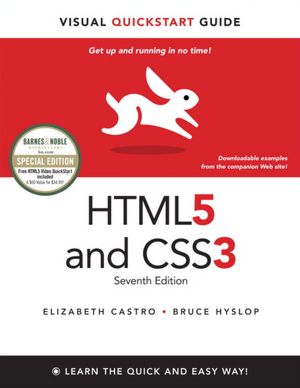
This is the eBook version of the printed book. Want to learn how to build Web sites fast? This best-selling guide's visual format and step-by-step, task-based instructions will have you up and running with HTML5 and CSS3 in no time. This Seventh Edition is a major revision, with approximately 125 pages added and substantial updates to (or complete rewrites of) nearly every page from the preceding edition. Authors Elizabeth Castro and Bruce Hyslop use clear instructions, friendly prose, and real-world code samples to teach you HTML and CSS from the ground up. Over the course of 21 chapters you will learn how to:
Write semantic HTML, both with elements that have been around for years and ones that are new in HTML5.Prepare images for the Web and add them to your pages.Use CSS to style text, add background colors and images, and implement a multicolumn layout.Build a single site for all users--whether they are using a mobile phone, tablet, laptop, desktop computer, or other Web-enabled device--based on many of the components of responsive Web design, including CSS3 media queries.Leverage new selectors in CSS3, add Web fonts to your pages with @font-face, and use CSS3 effects such as opacity, background alpha transparency, gradients, rounded corners, drop shadows, shadows inside elements, text shadows, and multiple background images.Improve your site's accessibility with ARIA landmark roles and other good coding practices.Build forms to solicit input from your visitors.Include media in your pages with the HTML5 audio and video elements.Test and debug your Web pages.Secure a domain name and publish your site. And much more! All book code samples and more are available on the companion web site.

Main Contents : 

Chapter 01 Web page building blocks
Chapter 02 Working with Web page Files
Chapter 03 basic htMl structure
Chapter 04 text
Chapter 05 images
Chapter 06 links
Chapter 07 Css building blocks
Chapter 08 Working with style sheets
Chapter 09 Defining selectors
Chapter 10 Formatting text with styles
Chapter 11 layout with styles
Chapter 12 Style sheets for Mobile to Desktop
Chapter 13 Working with Web Fonts
Chapter 14 Enhancements with Css3
Chapter 15 lists
Chapter 16 Forms
Chapter 17 Video, audio, and other Multimedia
Chapter 18 tables
Chapter 19 Working with scripts
Chapter 20 testing & Debugging Web pages
Chapter 21 publishing your pages on the Web

Direct Link Download :

Rapidgator : HTML5 & CSS3 Visual QuickStart Guide, 7th Edition

Ziddu : HTML5 & CSS3 Visual QuickStart Guide, 7th Edition

Mediafire : HTML5 & CSS3 Visual QuickStart Guide, 7th Edition


Book Detail : 
Print Length: 317 pages
Publisher: friendsofED; 1 edition (April 11, 2011)
Language: English
ASIN: B005PZ5D1Q | ISBN: 1430232919
File Size : 14.1 Mb | File Format : PDF

Book Description : 

Foundation HTML5 Canvas: For Games and Entertainment teaches you how to make exciting interactive games and applications using HTML5 canvas.

Canvas lets you produce graphics, animations, and applications using the HTML5 and JavaScript web standards. It allows you to draw directly within the browser without the need for third-party plugins like Adobe Flash, and so canvas works perfectly across desktop and mobile devices, like the iPhone and Android.

Foundation HTML5 Canvas begins by introducing you to HTML5 and the cool new features that it opens up for you. You are then offered a quick guide to JavaScript programming to get you up to speed. Next up you'll receive a thorough introduction to the canvas element, which teaches you how to draw objects within the browser with great ease.

Once the basics are covered you’ll move on to the more advanced features of canvas, including image and video manipulation. You’ll also learn how to create realistic animations with the help of some basic physics.

Foundation HTML5 Canvas then teaches you how to create two thrilling space-based games using all the skills you’ve learned so far. You'll find plenty of code examples and illustrations designed to help you understand even the most complex of topics.

HTML5 is already here for you, and this book will provide you with all the information you need to enjoy the show.

What you’ll learn
  • The exciting new features that HTML5 brings and how to use them
  • The basics of programming in JavaScript and capturing user input
  • What the canvas drawing element is all about and why you’d want to use it
  • How to utilize both basic and advanced features of canvas
  • How to create realistic animations using canvas and a splash of physics
  • How to make interactive games using canvas, JavaScript, and other HTML5 goodies
Who this book is for

The book has been written in a friendly way that makes it approachable to beginners and experts alike. It is predominantly for Web designers who are new to HTML5 and JavaScript, and covers the absolute basics of creating interactive games and applications using the HTML5 canvas element. Experienced Web designers and programmers will also learn about all the features of canvas and how they can be used within their own projects. Flash and Silverlight developers wanting to broaden their reach across the Web and mobile devices will also benefit from the information in this book.

Table of Contents

Introducing HTML5
Foundation JavaScript
Learning the Basics of Canvas
Pushing Canvas Further
Manipulating Images and Video
Making Things Move
Implementing Advanced Animation
Creating the Space Bowling Game
Creating the Asteroid Avoidance Game
Taking Things Further and the Future of Canvas

Direct Link Download :

Rapidgator : Foundation HTML5 Canvas For Games and Entertainment

Ziddu : Foundation HTML5 Canvas For Games and Entertainment

Mediafire : Foundation HTML5 Canvas For Games and Entertainment

Machine Learning for Hackers

Posted by Unknown On 3:25 AM | 1 comment

Book Detail 
Paperback: 324 pages
Publisher: O'Reilly Media; 1 edition (February 22, 2012)
Language: English
ISBN-10: 1449303714
ISBN-13: 978-1449303716
File Size : 20 Mb | File Format : PDF
Book Description 

If you’re an experienced programmer interested in crunching data, this book will get you started with machine learning—a toolkit of algorithms that enables computers to train themselves to automate useful tasks. Authors Drew Conway and John Myles White help you understand machine learning and statistics tools through a series of hands-on case studies, instead of a traditional math-heavy presentation.

Each chapter focuses on a specific problem in machine learning, such as classification, prediction, optimization, and recommendation. Using the R programming language, you’ll learn how to analyze sample datasets and write simple machine learning algorithms. Machine Learning for Hackers is ideal for programmers from any background, including business, government, and academic research.
  • Develop a naïve Bayesian classifier to determine if an email is spam, based only on its text
  • Use linear regression to predict the number of page views for the top 1,000 websites
  • Learn optimization techniques by attempting to break a simple letter cipher
  • Compare and contrast U.S. Senators statistically, based on their voting records
  • Build a “whom to follow” recommendation system from Twitter data
About The Authors 

Drew Conway is a PhD candidate in Politics at NYU. He studies international relations, conflict, and terrorism using the tools of mathematics, statistics, and computer science in an attempt to gain a deeper understanding of these phenomena. His academic curiosity is informed by his years as an analyst in the U.S. intelligence and defense communities.

John Myles White is a PhD candidate in Psychology at Princeton. He studies pattern recognition, decision-making, and economic behavior using behavioral methods and fMRI. He is particularly interested in anomalies of value assessment.

Brief of Contents 

Chapter 1 Using R
Chapter 2 Data Exploration
Chapter 3 Classification: Spam Filtering
Chapter 4 Ranking: Priority Inbox
Chapter 5 Regression: Predicting Page Views
Chapter 6 Regularization: Text Regression
Chapter 7 Optimization: Breaking Codes
Chapter 8 PCA: Building a Market Index
Chapter 9 MDS: Visually Exploring US Senator Similarity
Chapter 10 kNN: Recommendation Systems
Chapter 11 Analyzing Social Graphs
Chapter 12 Model Comparison

Download Ebook : Machine Learning for Hackers


Sunday, September 2, 2012

The CMDB Imperative

Posted by Unknown On 2:37 AM | 1 comment

Book Detail 
Paperback: 368 pages
Publisher: Prentice Hall; 1 edition (February 19, 2009)
Language: English
ISBN-10: 0137008376
ISBN-13: 978-0137008377
File Size : 3 Mb | File Format : PDF
Book Description 

Implementing an enterprise-wide Configuration Management Database (CMDB) is one of the most influential actions an IT organization can take to improve service delivery and bridge the gap between technology and the business. With a well-designed CMDB in place, companies are better positioned to manage and optimize IT infrastructure, applications, and services; automate more IT management tasks; and restrain burgeoning costs. Now, there’s an objective, vendor-independent guide to making a CMDB work in your organization. The CMDB Imperative presents a start-to-finish implementation methodology that works and describes how the CMDB is shifting to the superior Configuration Management System (CMS).

Expert CMDB industry analyst Glenn O’Donnell and leading-edge architect and practitioner Carlos Casanova first review the drivers behind a CMDB and the technical, economic, cultural, and political obstacles to success. Drawing on the experiences of hundreds of organizations, they present indispensable guidance on architecting and customizing CMDB solutions to your specific environment. They’ll guide you through planning, implementation, transitioning into production, day-to-day operation and maintenance, and much more. Coverage includes
  • Defining the tasks and activities associated with configuration management
  • Understanding the CMDB’s role in ITIL and the relationship between CMDBs and ITIL v3’s CMS
  • Building software models that accurately represent each entity in your IT environment
  • Ensuring information accuracy via change management and automated discovery
  • Understanding the state of the CMDB market and selling the CMDB within your organization
  • Creating federated CMDB architectures that successfully balance autonomy with centralized control
  • Planning a deployment strategy that sets appropriate priorities and reflects a realistic view of your organization’s maturity
  • Integrating systems and leveraging established and emerging standards
  • Previewing the future of the CMDB/CMS and how it will be impacted by key trends such as virtualization, SOA, mobility, convergence, and “flexi-sourcing”
Brief of Contents

Chapter 1: The Need for Process Discipline
Chapter 2: What Is a CMDB?
Chapter 3: Planning for the CMS
Chapter 4: The Federated CMS Architecture
Chapter 5: CMS Deployment Strategy
Chapter 6: Integration—There’s No Way Around It!
Chapter 7: The Future of the CMS
Chapter 8: Continual Improvement for the CMS
Chapter 9: Leveraging the CMS
Chapter 10: Enjoy the Fruits of Success

Download Ebook : The CMDB Imperative

Rapid : The CMDB Imperative
Ziddu : The CMDB Imperative